
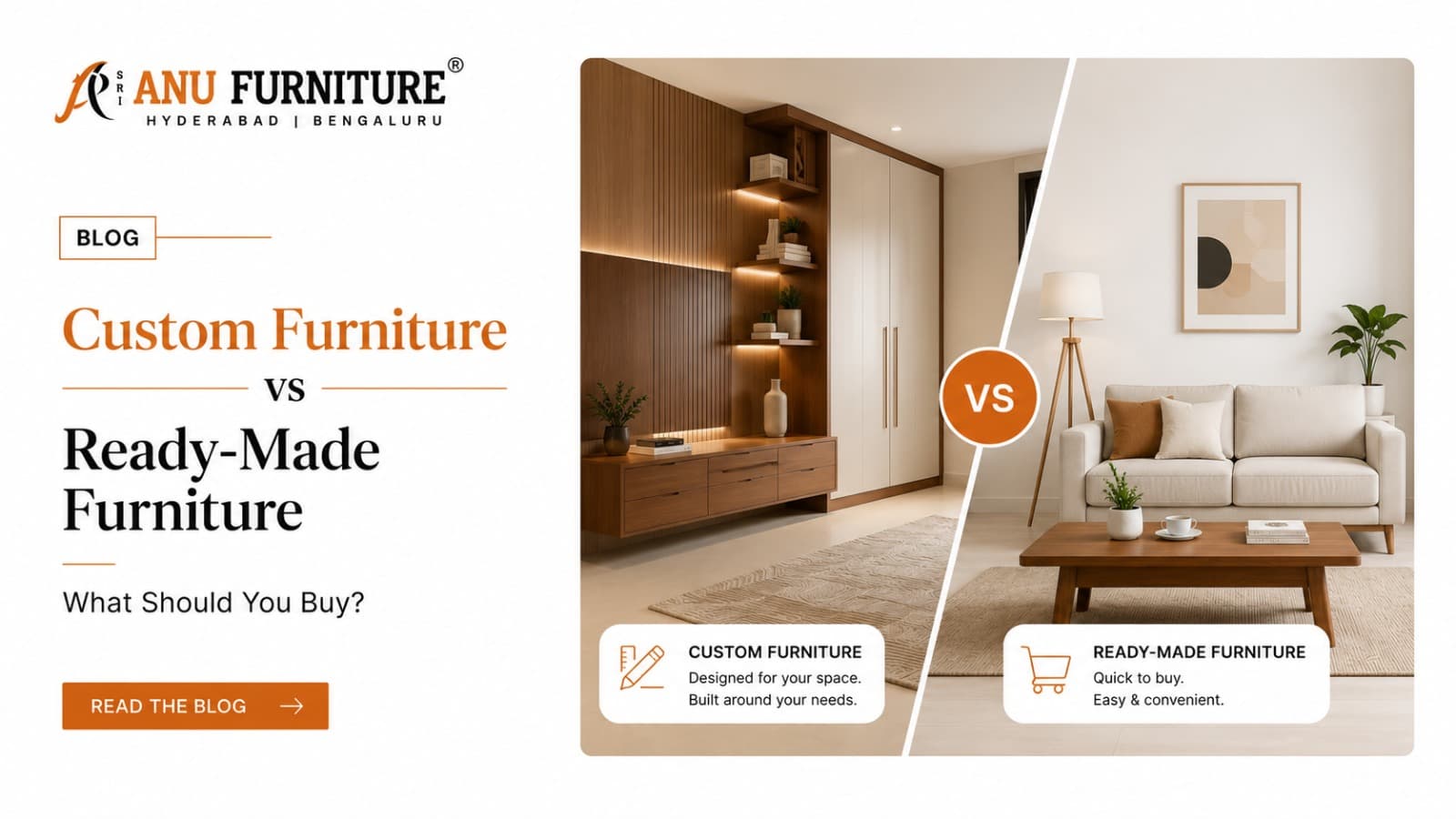
You’ve finally found time to furnish that empty corner of your living room. You open a shopping app, and within seconds you’re faced with a decision that seems simple but isn’t: do you order the sleek sofa that ships in a week, or do you call a local carpenter and wait six weeks for something made just for you?
This is one of the most common dilemmas in home design, and honestly, there’s no universally “right” answer. The best choice depends on your budget, your timeline, your space, and how much you care about having something nobody else owns. Let’s break down the custom vs ready-made furniture debate so you can make a decision you won’t second-guess later.
What Is Ready-Made Furniture, Exactly?
Ready-made furniture is exactly what it sounds like — pieces manufactured in bulk, following standard designs and dimensions, and sold as-is through stores or online retailers. Think of the sofas, dining sets, and wardrobes you see in showrooms or scroll past on furniture websites. They’re built to fit “average” spaces and “average” needs, which is precisely their biggest strength — and their biggest limitation.
The Case for Ready-Made Furniture
• Speed. You can literally buy it today and have it in your home within days.
• Affordability. Mass production keeps costs down, especially for budget and mid-range pieces.
• Convenience. No design consultations, no waiting on craftsmen, no back-and-forth over finishes — just browse, buy, and unbox.
• Easy to compare. With thousands of options online, it’s simple to compare prices, reviews, and styles side by side before committing.
Ready-made furniture makes the most sense when you’re working with a tight deadline (hello, move-in day), a modest budget, or a space that happens to match standard dimensions.
What Is Custom Furniture, Exactly?
Custom furniture is built specifically for you — your measurements, your material preferences, your color palette, sometimes even your quirks (yes, you can request a coffee table with rounded corners because your toddler runs everywhere). It’s usually made by independent carpenters, small studios, or specialized furniture brands that offer bespoke services.
The Case for Custom Furniture
• Perfect fit. If you have an awkward alcove, a narrow hallway, or a room with unconventional dimensions, custom furniture solves problems ready-made pieces simply can’t.
• Better material control. You choose the wood, the upholstery, the hardware — right down to the finish and grain pattern.
• Built to last. Custom pieces are often crafted with more durable joinery and higher-grade materials, since they’re made one at a time rather than optimized for mass output.
• Reflects your personality. No two custom pieces are exactly alike, which matters if you want your home to feel distinctly yours rather than catalog-perfect.
The tradeoff? Custom furniture usually costs more and takes weeks — sometimes months
— to complete. It requires patience and, often, a clearer sense of what you actually want before you start the process.
Custom Furniture vs Ready-Made Furniture: A Side-by-Side Look
| Factor | Ready-Made Furniture | Custom Furniture |
| Cost | Generally lower | Generally higher |
| Delivery time | Days | Weeks to months |
| Fit for unusual spaces | Limited | Excellent |
| Material choice | Fixed options | Fully customizable |
| Uniqueness | Mass-produced | One-of-a-kind |
| Longevity | Varies by brand | Often built to last longer |
| Best for | Quick furnishing, tight budgets, standard rooms | Long-term investment, unusual layouts, personalized style |
Questions to Ask Yourself Before Deciding
Since this decision isn’t purely about money, it helps to ask a few honest questions before you commit either way.
1. How much time do you actually have? If you’re moving in next week and need a bed frame, custom furniture probably isn’t realistic no matter how appealing it sounds.
2. Does your space have unusual dimensions? An oddly shaped nook, a low ceiling, or a narrow staircase can turn “just buy something online” into a logistical headache. This is where custom shines.
3. What’s your actual budget — not your ideal one? Custom furniture can range from moderately priced to significantly expensive, depending on materials and craftsmanship. Be realistic about what you’re willing to spend before falling in love with a design.
4. How long do you plan to stay in this home? If you’re renting short-term or expect to move again soon, ready-made furniture that’s easy to resell or transport might make more practical sense.
5. Do you want something functional, or something meaningful? Some people just need a table to eat dinner on. Others want a piece with a story — the wood their grandfather might have chosen, the exact shade that matches their favorite childhood home. Custom furniture caters to the latter.
Can You Mix Both? Absolutely.
Here’s something most furniture buying guides don’t mention enough: you don’t have to pick a side. Plenty of well-designed homes combine both approaches strategically. A common and smart approach is:
◦ Buy ready-made for high-turnover items like bookshelves, side tables, or kids’ furniture that will likely be replaced as needs change.
◦ Invest in custom for anchor pieces — a dining table, a bed frame, a built-in wardrobe
— that define the room and need to fit exactly right.
This hybrid strategy lets you control costs without sacrificing the personalized feel that makes a house look like your home.
Final Verdict: There’s No Universal Winner
The custom vs ready-made furniture question isn’t about which option is objectively better — it’s about which one fits your specific situation right now. Ready-made furniture wins on speed, affordability, and convenience. Custom furniture wins on fit, quality, and individuality.
If you’re furnishing in a hurry or on a tight budget, ready-made is the practical choice. If you have an unusual space, a long-term view of your home, or simply want furniture that feels unmistakably yours, custom is worth the wait and the extra cost.
Whichever direction you choose, the goal is the same: furniture that makes your house function better and feel more like home — not just something that fills a room.