
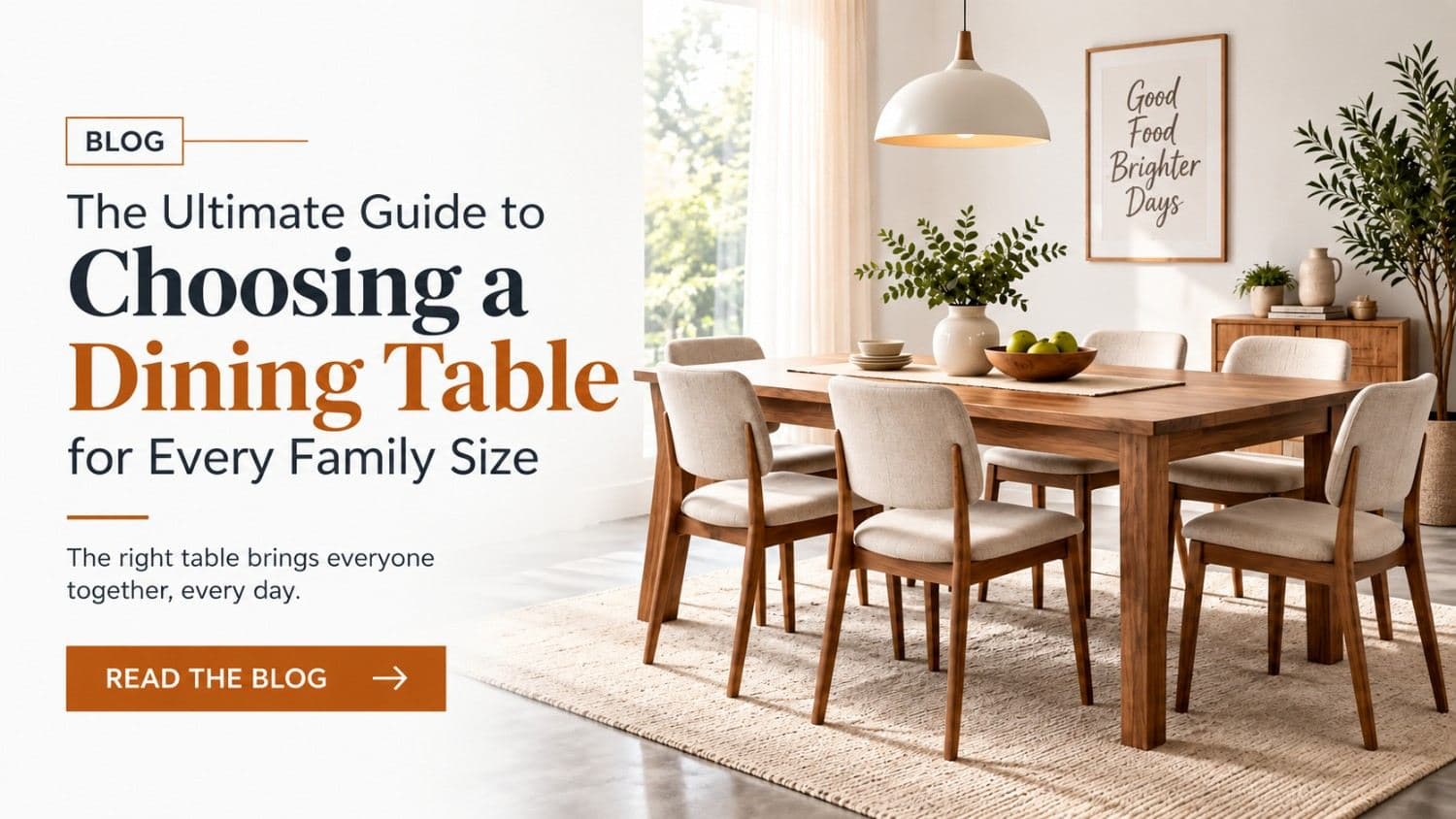
If you’ve ever stood in a furniture showroom, tape measure in one hand and phone calculator in the other, trying to figure out whether “that gorgeous table” will actually fit your dining room — you already know that buying a dining table is rarely as simple as picking the prettiest one. It’s the piece of furniture your family will gather around for birthdays, homework sessions, Sunday breakfasts, and everything in between. So it deserves more than a
five-minute decision.
This guide walks you through everything you need to think about when choosing the right dining table for family life, whatever that looks like for you — from cozy two-person households to sprawling multigenerational homes.
Why the Right Dining Table Matters More Than You Think
A dining table isn’t just furniture — it’s the anchor of your home’s social life. It’s where conversations happen, where kids do art projects, where laptops get parked during work-from-home days, and where holiday feasts unfold. Choosing the wrong one — too
small, too fragile, or too awkward to move around — creates friction you’ll notice every single day.
That’s why a proper dining table buying guide should start not with style, but with how your family actually lives.
Step 1: Measure Your Space Before You Fall in Love with a Table
It’s tempting to shop by looks first, but measurements come first — always. Here’s a simple framework:
• Leave at least 36 inches of clearance around the table so chairs can slide out comfortably and people can walk past even when others are seated.
• Measure your doorways and hallways, not just the dining room. A table that fits the room but can’t make it through the front door is a costly mistake.
• Account for a rug, if you plan to use one. Ideally, the rug should extend about 24 inches beyond the table edge on all sides.
Sketch your room dimensions (or use a free room-planning app) before you start browsing. It saves you from returns, restocking fees, and heartbreak.
Step 2: Match the Table Size to Your Family Size
This is where most buying guides get too generic. The truth is, “family size” isn’t just about headcount — it’s about how often you host, whether your kids are still in high chairs, and if grandma visits every weekend.
Small Families (2–4 People)
For couples, small families, or empty nesters, a dining table for small and large families doesn’t have to mean going big. A round or square table between 36 and 48 inches works beautifully in cozy kitchens or apartments. Round tables are especially smart for small spaces because they don’t have sharp corners to navigate around, and they make conversation feel more intimate.
Look for:
• Drop-leaf or extendable designs for flexibility when guests come over
• Bistro-style tables if space is extremely tight
• Lighter materials that are easy to move for cleaning or rearranging
Medium Families (4–6 People)
This is the sweet spot for most households, and it’s also the widest category in terms of design options. A rectangular table around 60–72 inches long comfortably seats six without feeling cramped. If your family is growing or you host occasional dinner parties, consider an extendable dining table with a removable leaf — you get everyday practicality with occasional-guest flexibility.
Large or Multigenerational Families (6–10+ People)
If your dining room doubles as command central for holidays, tutoring sessions, and Sunday dinners with three generations under one roof, you need a table built for volume.
Rectangular or oval tables from 84 to 120 inches are standard here. Farmhouse-style tables are especially popular for large families because of their durability and casual, welcoming feel.
For extra flexibility, some families choose two smaller tables that can be pushed together for big occasions and separated for daily use — a clever workaround if your space can’t permanently accommodate a giant table.
Step 3: Choose a Shape That Fits Your Lifestyle, Not Just Your Room
Among the best dining table designs, shape matters just as much as size:
• Round tables encourage conversation and are forgiving in tight or oddly shaped rooms.
• Rectangular tables are the most space-efficient for larger families and pair easily with bench seating.
• Square tables work well for small, intimate dining areas.
• Oval tables offer a nice middle ground — the seating capacity of a rectangle with softer, safer edges (a bonus if you have toddlers running around).
Step 4: Pick a Material That Matches Your Family’s Habits
Be honest with yourself here. If you have young kids, pets, or a habit of eating with enthusiasm, a delicate glass-top table probably isn’t the move.
• Solid wood (oak, walnut, acacia) is durable, ages beautifully, and can usually be refinished if it gets scratched.
• Engineered wood offers a similar look at a lower price point, though it’s less resistant to heavy wear.
• Glass looks elegant and works well in small spaces because it visually “disappears,” but it shows fingerprints and isn’t ideal for households with young children.
• Metal and reclaimed wood combinations suit industrial or rustic aesthetics and tend to be extremely sturdy for large, active families.
Step 5: Don’t Forget the Chairs (and the Math)
A common mistake in any dining table buying guide is focusing entirely on the table and treating chairs as an afterthought. As a rule of thumb, allow 24 inches of table width per person so elbows don’t collide. Mixing dining chairs with a bench on one side is a popular trick for large families — it adds flexible seating without requiring extra floor space.
Step 6: Think About How the Table Will Age With Your Family
Kids grow up, families expand or shrink, and homes change. Extendable tables are worth the slight premium because they adapt instead of becoming obsolete. If budget allows, choose a design that can serve you well beyond this year — not just this season.
Final Thoughts
Choosing the right dining table isn’t about finding the trendiest design online — it’s about finding the piece that fits how your family actually eats, gathers, and lives. Whether you’re furnishing a compact apartment for two or setting up a farmhouse table for a full house of relatives every weekend, the right table becomes more than furniture. It becomes the backdrop for thousands of everyday meals and a handful of unforgettable ones.
Take your time, measure twice, and choose a table that will grow with your family — not just fit it for now.